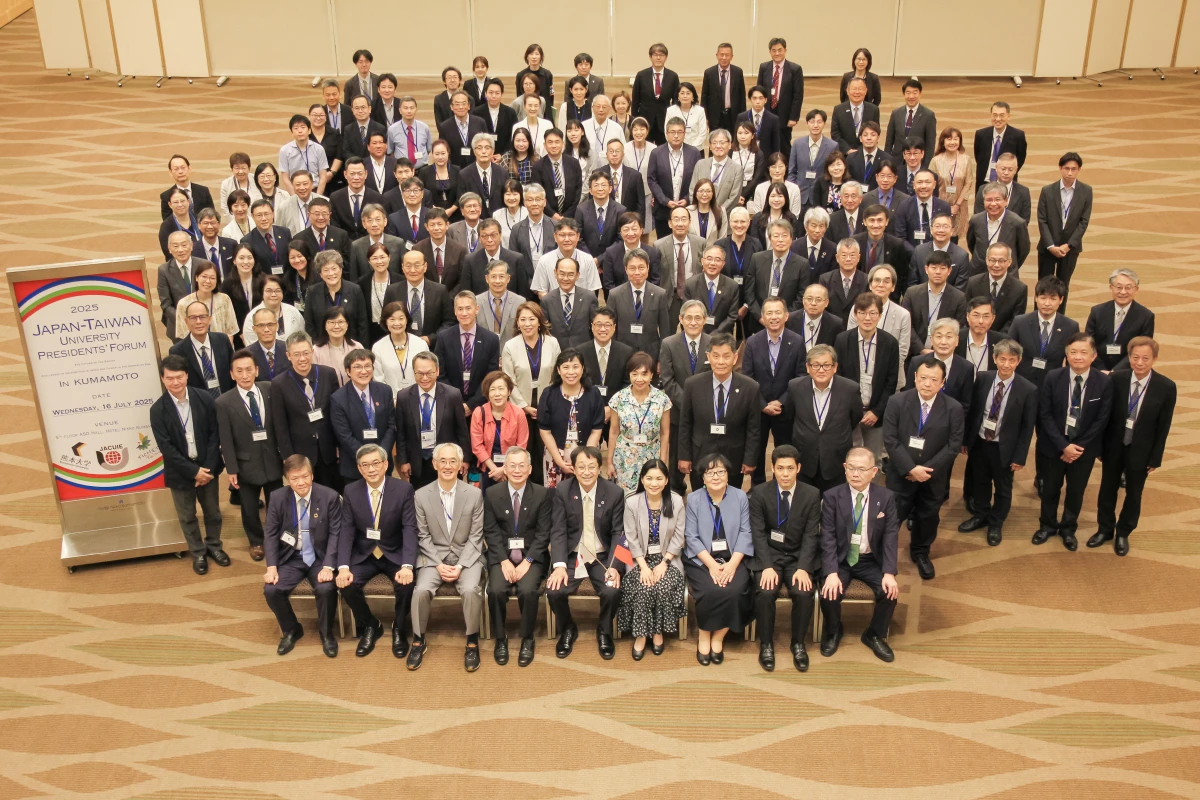
The 2025 Taiwan–Japan University Presidents’ Forum was held on July 16 in Kumamoto, Japan, bringing together approximately 160 representatives from more than 80 universities and institutions of higher education in both countries. This year’s forum was organized around the theme, “The Future of the Region: Challenges of Universities in Japan and Taiwan in the Innovative Era,” focused on key issues including student and early-career scholar exchange, university–industry collaboration for regional development, the role of universities in disaster response, and the digital transformation of higher education.
Initially launched in 2016, the biennial forum is co-organized by the Foundation for International Cooperation in Higher Education of Taiwan (FICHET) and the Japan Committee of Universities for International Exchange (JACUIE), with hosting responsibilities alternating between the two countries. 2025 marks the fourth in-person Forum, with Kumamoto University hosting many university presidents and their attending faculty and staff—underscoring the strength and continuity of Taiwan–Japan academic ties.
Opening remarks were delivered by Director General Yu-Jiuan Lee of the Department of International and Cross-Strait Education of Taiwan’s Ministry of Education. Japan is one of the four leading sources of inbound international students in Taiwan and a key partner in the development of Mandarin language education. As of 2025, 8,779 Japanese students are studying in Taiwan, with more than 3,200 enrolled in Mandarin programs—reflecting strong educational and cultural exchange.
FICHET Chairperson Tsai-Yen Li noted that this year’s forum also marked an update of the signatories to the memorandum of understanding between FICHET and JACUIE, reaffirming the commitment to deepening bilateral cooperation. He expressed hopes for enhanced collaboration platforms, meaningful academic exchanges, and talent development aligned with the evolving needs of both nations. He also encouraged more Japanese students to study in Taiwan, further strengthening bilateral ties in higher education.
The choice of Kumamoto as the host city also reflects growing connections between Taiwan and Kumamoto in the semiconductor sector. One keynote address focused on the profound transformation underway in the semiconductor and digital industries—driven by innovation, geopolitical shifts, and global economic realignment—pointing to new opportunities for Taiwan–Japan collaboration.
A common theme throughout the Forum’s meetings and presentations emphasized that, in the face of global change, universities in both countries share a responsibility to foster regional development and cultivate future talent. They called for continued cooperation through the Forum, including the further development of early-career scholar exchanges, shared bilingual teaching resources, and joint digital learning initiatives. These efforts are viewed as key to strengthening academic–industry linkages and enhancing the region’s global competitiveness.



![[Forward News] 𝐈𝐍𝐓𝐄𝐍𝐒𝐄 𝐏𝐫𝐨𝐠𝐫𝐚𝐦𝐬 (International Industrial Talents Education Special Program)](/album/files/97160f98980cabe554243950+cw500h280.webp)
![[Forward News] MOE Short Term Research Award](/album/news/6697338f86479+cw500h280.webp)
![[FICHET Higher Ed in Taiwan Newsletter] Flying High in Higher Ed: Taiwan's Unmanned Revolution](/album/files/c859324572bdc94694075dae+cw500h280.webp)

![[Forward News] TSMC fab in Japan attracts semiconductor students to Taiwan](/assets/img/default_cover.webp)

