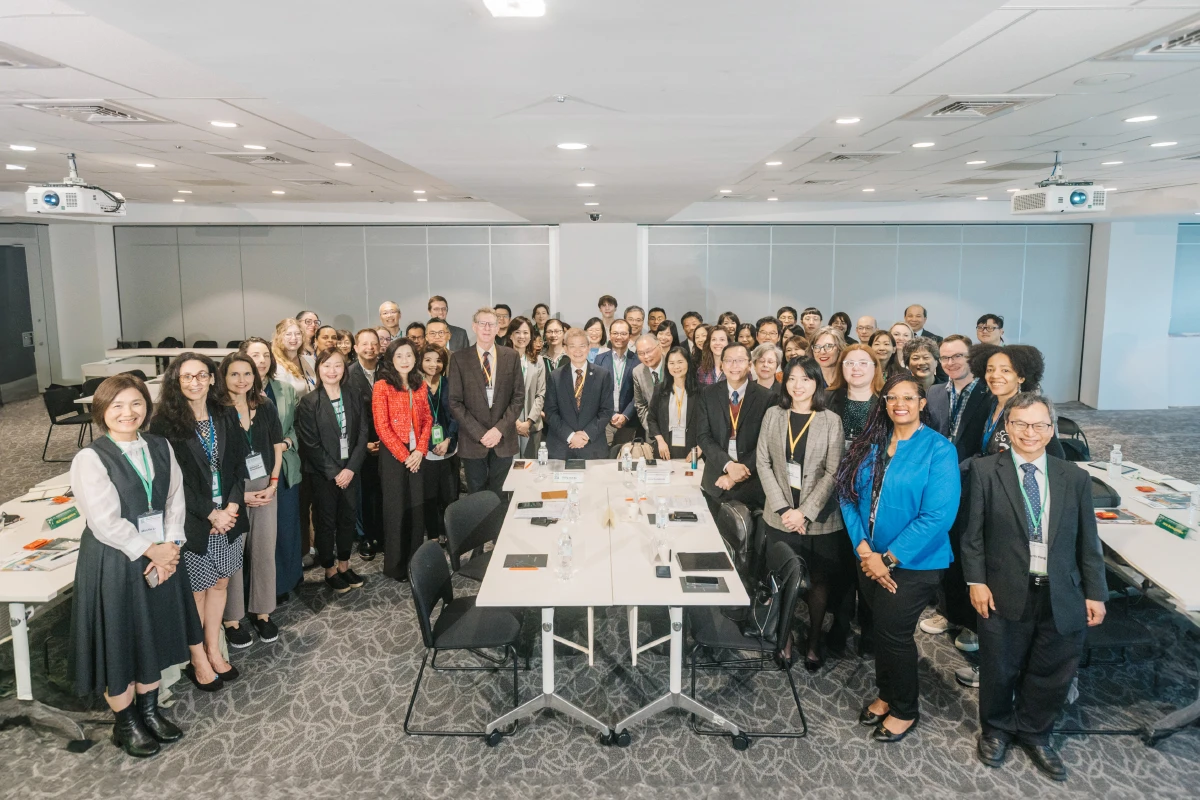
2025 Taiwan-U.S. International Education Administrators (IEA) Roundtable Networking was held on March 14 at Taipei New Horizon. Hosted by the Foundation for International Cooperation in Higher Education of Taiwan (FICHET) and the Foundation for Scholarly Exchange (Fulbright Taiwan), the event brought together nearly 70 representatives from 40 Taiwanese universities and 16 U.S. universities to explore the future of bilateral educational and academic research collaboration, further fostering Taiwan-U.S. higher education partnerships.
Director General, Yu-Jiuan Lee, of the Department of International and Cross-strait Education, Ministry of Education, highlighted that Taiwan-U.S. higher education exchanges have spanned several decades, leading to the signing of over 2,000 academic cooperation agreements. Currently, more than 20,000 Taiwanese students study in the United States, while nearly 4,000 American students study in Taiwan, with over 60% enrolled in Mandarin language programs. Since the launch of the U.S.-Taiwan Education Initiative in 2020, language education collaboration between the two countries has deepened significantly. The Ministry of Education’s Huayu BEST Program has facilitated partnerships between 18 Taiwanese universities and 58 U.S. academic institutions, sending over 70 Mandarin teachers and teaching assistants to the U.S. in 2024. Moving forward, the ministry will continue to promote language and educational exchanges with the U.S.
Cheng-Chih Wu, Chairperson of FICHET, emphasized that the United States is a key partner in the development of Taiwan’s higher education. The two sides have long worked together to deepen collaboration, facilitate academic exchanges, expand language education programs, and strengthen institutional partnerships. Under the U.S.-Taiwan Education Initiative, both countries have enhanced support for Mandarin and bilingual programs, increased scholar and student exchanges, and bolstered STEM and semiconductor-related academic and research collaborations—efforts that have already yielded significant results. Wu expressed appreciation for the strong engagement from Taiwanese universities and commended Fulbright Taiwan for its efforts in leading U.S. international education delegations to Taiwan, enabling face-to-face exchanges between institutions and the establishment of a friendly and effective communication platform.
Executive Director Randall Nadeau of Fulbright Taiwan underscored the organization's active promotion of bilateral cooperation through various initiatives, including the Fulbright Internship Program, which supports Taiwanese students and faculty in studying in the U.S. while also encouraging American students and faculty to engage with Taiwan. Additionally, the foundation co-organizes lectures, short-term programs, and Taiwan-U.S. initiative related events with universities, covering topics such as EMI, Mandarin education, and cultural exchange. Nadeau also expressed hope that by continuing to organize annual U.S. international education delegations to Taiwan, the two countries can further strengthen their educational cooperation.
At the roundtable event, First Education Secretary, Canny Yi-Ken Liao of the Ministry of Education’s Department of International and Cross-strait Education provided an overview of Taiwan-U.S. educational collaboration and shared insights on Taiwan’s major higher education policies and scholarship opportunities. The discussion also covered potential future opportunities for bilateral education cooperation.
From the U.S. side, Anize Appel, Dean of the Center for Global Education at Moravian University, and Christina Kinney, Director of the Office of International Education and Global Engagement at Kutztown University, shared their perspectives on U.S. academic strengths and international collaboration experiences, offering unique insights into cross-border partnerships.
To deepen U.S. participants’ understanding of Taiwan’s Mandarin education initiatives, the event featured a presentation by Chen-Cheng Chun, Chairperson of Association of Teaching Chinese as a Second Language, who introduced innovative Mandarin teaching and best practices.
The final group networking discussion saw enthusiastic exchanges between IEA scholars from 16 U.S. universities, including the University of Southern California, University of Texas at Austin, and University of Iowa, and their Taiwanese counterparts. Representatives from both sides actively engaged in discussions on academic cooperation opportunities and future developments, laying the groundwork for new collaboration prospects in higher education between Taiwan and the U.S.


![[Forward News] 𝐈𝐍𝐓𝐄𝐍𝐒𝐄 𝐏𝐫𝐨𝐠𝐫𝐚𝐦𝐬 (International Industrial Talents Education Special Program)](/album/files/97160f98980cabe554243950+cw500h280.webp)
![[Forward News] MOE Short Term Research Award](/album/news/6697338f86479+cw500h280.webp)
![[FICHET Higher Ed in Taiwan Newsletter] Flying High in Higher Ed: Taiwan's Unmanned Revolution](/album/files/c859324572bdc94694075dae+cw500h280.webp)

![[Forward News] TSMC fab in Japan attracts semiconductor students to Taiwan](/assets/img/default_cover.webp)

