Welcome to our inaugural newsletter focusing on Taiwan’s higher education sector. We at the Foundation for International Cooperation in Higher Education of Taiwan (FICHET) aim to connect Taiwan’s higher education sector to the world. In this edition, we take a look at Taiwan’s recent exciting developments in the field of AI (and it’s definitely more than chips). We’ll explore the collaboration between academia, industry, and government, and how Taiwan is nurturing talent, driving innovation, and creating opportunities in the AI sector.
Higher Ed x Industry
Industry-Academia Cooperation: Taiwan Launches Groundbreaking AI Alliance
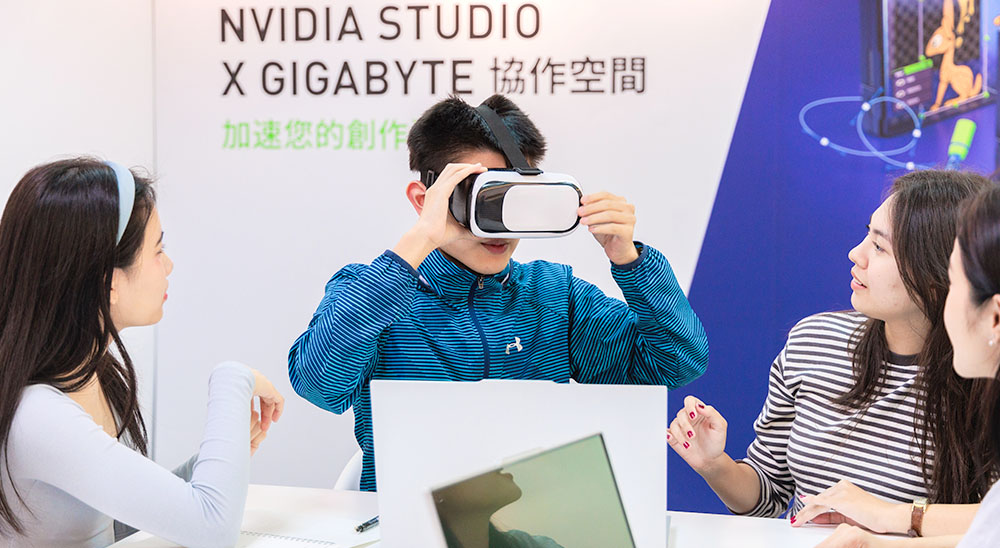
Nvidia works closely with Taiwanese universities. Photo: FICHET
Taiwan’s Ministry of Education (MOE) and 25 universities have joined forces to launch a landmark project—Taiwan Artificial Intelligence College Alliance (TAICA). This initiative brings together the AI learning resources from all participating universities and forms a “Team Taiwan” to prepare students with AI-related expertise. Spearheaded by National Taiwan University, National Tsing Hua University, and National Cheng Kung University, the alliance will start by offering four programs: AI exploration and application, AI industrial application, AI and natural language processing, and AI and visual technology application. Students who complete the programs will receive a certificate issued by the MOE. In the fall 2024 semester, 2,527 Taiwanese college students have registered in courses offered by TAICA.
IBM Consulting, Taiwan has expressed interest in recruiting students who obtain certificates through the AI alliance programs. This direct pathway from education to employment underscores the practical value of the alliance and its potential to shape Taiwan’s future workforce in AI. Moreover, support from business such as IBM Consulting, Taiwan reaffirms the government’s vision of building Taiwan as the destination for AI education in the region.
Taiwan’s universities have already gained significant traction in working with AIrelated companies in recent years. Nvidia CEO Jensen Huang named nine national universities and eight private ones that have supported Nvidia’s vision in his COMPUTEX 2024 keynote. Some collaborative projects include AI research center, software support, and AI education. Notably, the Nvidia Studio x GIGABYTE Collaboration Space at the National Taiwan Normal University (NTNU) integrates Nvidia’s Studio platform that features motion capture and real-time preview in virtual realty. NTNU also partners with other industry leaders in other AI-enabled technologies, utilizing strengths from industry, government, and academia to accelerate the development of AIoT applications.
With strong industry partnerships already in place, Taiwan is committed to advancing AI education and application, potentially setting a model for other countries in bridging the gap between academia and industry in the rapidly evolving field of artificial intelligence.
Research & Programs
Taiwan To Designate More Resources in AI Applications
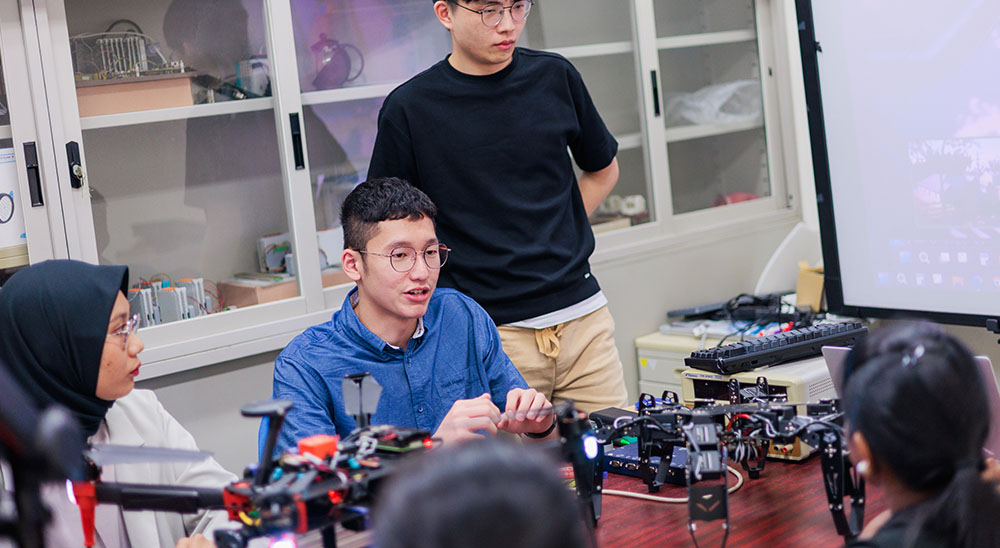
Students of National Central University's international AI graduate program. Photo: FICHET
In a move to help boost AI research and development capabilities, Taiwan’s Ministry of Economic Affairs has granted four Taiwanese teams free access to Taipei-1, a Kaohsiung-based supercomputer built by Nvidia. Trustworthy AI Dialogue Engine (TAIDE), one of the teams awarded the access, is a government-initiated project that aims to build an LLM based on Taiwan's own language data. The researchers are from institutions including National Yang Ming Chiao Tung University and National Chengchi University. The AI on Chip Taiwan Alliance (AITA) is another team granted access to Taipei-1. AITA’s goal is to expedite the research and application of AIembedded chips, and one of its member is Taipei Medical University that looks into medical data applications.
Meanwhile, Academia Sinica, Taiwan’s premier research institution, established an AI promotion office on July 1, 2024. The institution will explore AI applications in humanities and social sciences using its extensive databases while assessing societal implications of AI. Many Taiwanese universities have now included AI components in their humanities curriculum to familiarize students with the tools and guide them to creatively and responsibly use AI. Tunghai University has included AI in its mandatory Mandarin courses and put an emphasis on critical thinking and communication. Yuan Ze University’s humanities college has also put AI applications as a required course in 2024, setting the foundation for students to use the technology in different humanities majors.
Taiwan’s National Development Council has recently noted that Taiwan will be dedicating more resources into AI applications, a relatively weaker area compared to the nation’s AI chip manufacturing sector. This strategic shift aims to create a more balanced AI ecosystem, leveraging existing hardware strengths to boost software and application development.
Study & Work
Taiwan Government to Strengthen Global Talent Policy While Schools Consolidating Diverse Partnerships
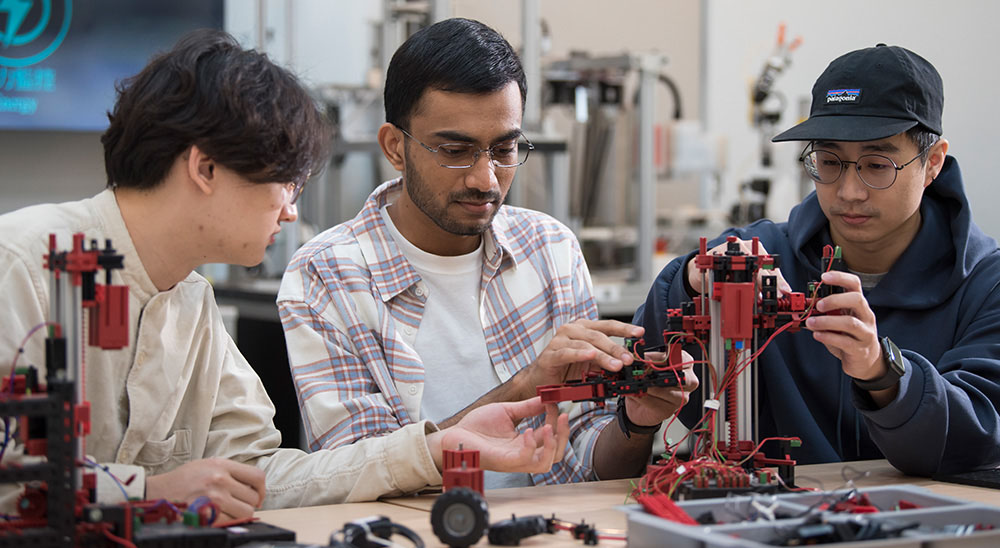
International students at Taiwan Tech's Institute of Intelligent Manufacturing Technology. Photo: FICHET
Taiwan to Expand Global Talent Policy to Boost International Competitiveness
Taiwan has recently issued the 10,000th Employment Gold Card for foreign talents. The card combines visa, work permit, and residence permit and is issued to highlyskilled non-citizen individuals across various industries. The government is also actively taking steps to attract more global talents to work in Taiwan.
Domestically, the government plans to eliminate quota limits and points systems for international and overseas compatriot students who wish to work in Taiwan after graduation. This change would provide more assurance to students and encourage them to stay in Taiwan. Currently, these students must work in one of 15 designated occupations and accumulate at least 70 points across eight criteria. The National Development Council has also initiated a research project that aims to understand the difficulties and experiences of international students interning or working in Taiwan to provide the government with concrete recommendations.
The government is also planning the rollout of global elite cards. These cards will offer more incentives than the existing Employment Gold Cards, including permanent residency after one year, social benefits, and work permits for spouses. Parents and grandparents of global elite cardholders would also be granted unlimited stay in Taiwan.
AI Partnerships Enhance University Programs Across Diverse Fields
Taiwan’s universities are increasingly forging partnerships with government, industry leaders, and institutions abroad to advance AI research and education across various disciplines, with the goals of enhancing research capabilities and making academic programs more relevant and attractive to students.
Feng Chia University is leading Taiwan's AI and urban development through its ROSO Robotics Construction Laboratory and 5G experimental network. Partnering with Taichung City Government and industry leaders, the university focuses on intelligent construction solutions and smart city technologies, while its three colleges drive innovations in manufacturing, digital transformation, and urban governance.
Tamkang University is partnering with Asia Cement to provide comprehensive AI training programs for corporate staff, adding to its existing collaboration with Far EasTone and network of 30 industry partners. The initiative aims to enhance corporate AI capabilities through customized courses ranging from basic literacy to advanced applications.
Additionally, Chinese Culture University has partnered with O-PA Technology, with the aim of expanding AI technology into the field of smart sustainability, offering students academic courses and practical opportunities in AI and ESG applications. National Taiwan Ocean University’s College of Ocean Law and Policy has signed research and exchange agreements with Vietnam National University, Hanoi and the University of Malaya, with a particular emphasis on exploring the use of AI in maritime law.
These partnerships demonstrate how universities are expanding their research scope and making their programs more relevant and attractive to students, preparing students for the evolving demands of the global job market.
Taiwan Leverages Mandarin Programs to Attract Global Talent
Taiwan is strategically positioning itself as a hub for international education through innovative Mandarin language partnerships with prestigious institutions worldwide. Key initiatives in 2024 include the Harvard Taipei Academy at National Taiwan University and the Middlebury School at National Sun Yat-sen University, both offering immersive language programs. Students participate in traditional cultural activities while gaining exposure to Taiwan’s cutting-edge tech industry through company visits and specialized courses. This educational strategy aligns with Taiwan’s broader initiative to attract international talent to its growing AI sector.
In addition, the Chinese Language and Technology Center (CLTC) at the National Taiwan Normal University (NTNU) is developing AI systems capable of emotional recognition and empathetic response, offering personalized learning experiences that surpass traditional digital learning methods in terms of student satisfaction and motivation. Utilizing NTNU's Mandarin-learning and testing data—the largest in Taiwan—CLTC is able to study learning patterns and make improvement recommendations. This technology, combined with physical robot interfaces, provides adaptive assistance to learners, addressing limitations in traditional educational approaches. CLTC also has a suite of digital tools that can aid in learning Mandarin, including SmartPinyin for pronunciation, AES-Han for writing feedback, and SmartReading for adaptive assessment.
Beyond Education
Businesses and Government Working Together to Build an “AI Island”
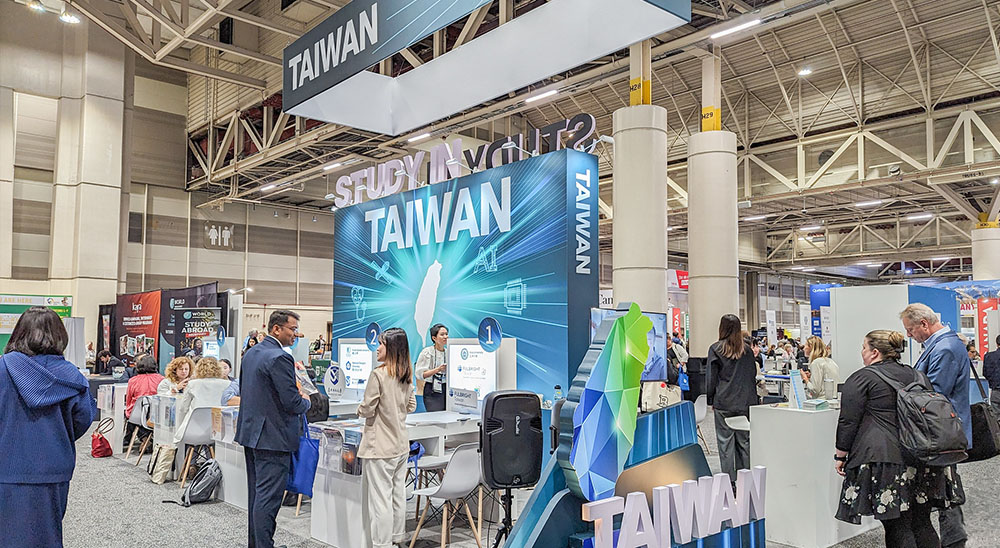
The "technology island" stand at the Study in Taiwan booth at NAFSA 2024. Photo: FICHET
Taiwan’s government and private sector are working together in positioning Taiwan as an "AI Island," leveraging its strengths in hardware manufacturing to create a complete AI chain and attract both local and foreign investment.
Local companies are making significant strides in AI development. While TSMC continues to play a crucial role in AI chip manufacturing, Pegatron Corp chairman highlighted the island’s manufacturing capabilities in cloud equipment and edge devices in the 2024 annual conference of Taiwan AI Academy. In addition, Wistron Corp has announced partnership with Zettabyte to build Taiwan’s first hyperscale AI data center, which aims to satisfy growing demand for AI computing in Taiwan and the Asia Pacific region.
Foreign investment in Taiwan’s AI sector is also on the rise. The Ministry of Economic Affairs recently hosted SEMICON Taiwan 2024, where 12 foreign enterprises signed investment letters of intent worth an estimated NT$46 billion (US$1.43 billion). These companies, from countries including the United States, Japan, and European nations, recognize Taiwan’s critical position in the AI supply chain and are investing in various fields related to AI and semiconductors. Additionally, the Taiwan Science and Technology Hub at Stanford University is fostering collaboration between Taiwan and Silicon Valley, aiming to bring innovative thinking back to Taiwan and develop application service systems.
School Highlight
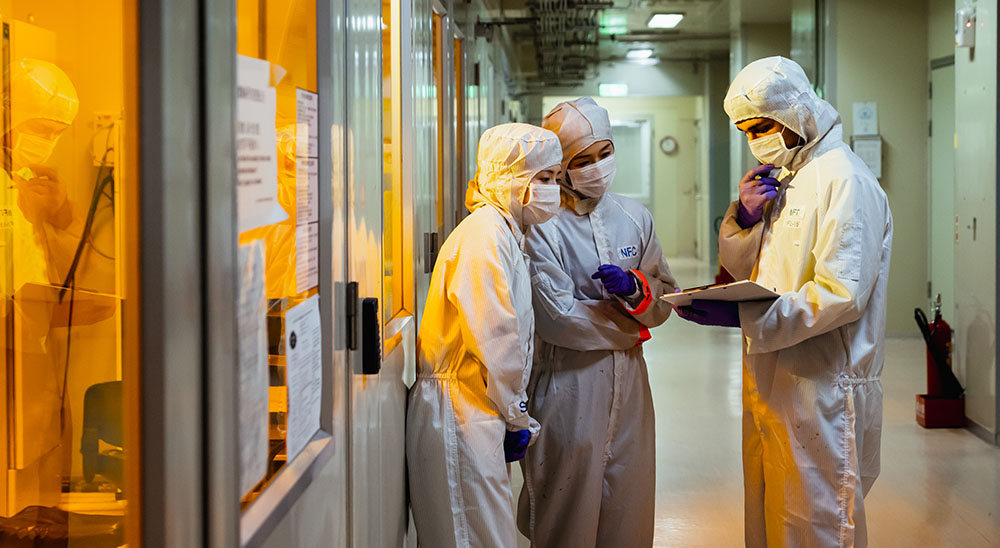
Students of the International College of Semiconductor Technology, NYCU. Photo: FICHET
National Yang Ming Chiao Tung University (NYCU) is singularly unique as it pioneers Taiwan’s most innovative smart medical research.
Yangming Campus focuses on biomedical research, and Chiaotung Campus focuses on electronic communication research. NYCU combines the strengths of both campuses to jointly develop medical applications in terms of AI, telemedicine, medical robots, Internet of Things, wearable devices, and blockchain biomedical as Eco-system amongst other developments.This will turn NYCU into a world-class base for initiating a smart and healthy life to cement Taiwan as the new model for global smart medical care.
At present, there are 19 colleges and 74 university/college-level research centers. Faculties include: artificial intelligence and green energy, biological science and technology, computer science, dentistry, humanities and social sciences, Hakka studies, law, life sciences, medicine, nursing, management, and general education.
As the era of AI approaches and human beings pursue a healthier life, NYCU, with its combined expertise in biomedicine and electronic communications, will both cultivate high-quality talent and provide creative solutions.
From FICHET Study in Taiwan
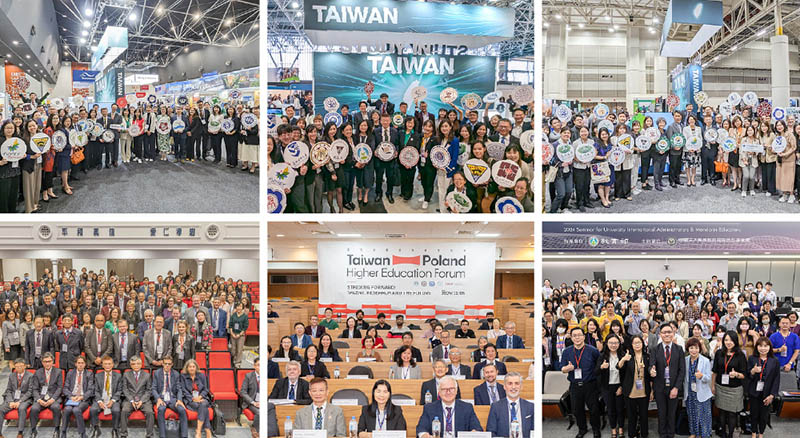
Season’s greetings from FICHET! We are a non-profit organization funded by Taiwan’s higher education institutions to advocate international partnerships. Part of our job is to operate the Study in Taiwan brand to promote Taiwan’s higher education. We play an active role in major international educator events and led delegations of university representatives at APAIE, NAFSA, and EAIE this year. We also work with international partners and organize events such as the 2024 Taiwan-France and Taiwan-Poland higher education forums.
The AI boom has propelled Taiwan to the global center stage, and the higher education sector in Taiwan is actively working with the government and businesses to ensure they deliver the most relevant and practical programs. Taiwan is also an ideal study destination for international students. Three of our cities—Taipei, Hsinchu, and Tainan—have been recognized among the world’s top 100 best student cities by QS Rankings, and our healthcare system was ranked top among 110 countries by CEOWORLD magazine.
We hope you have found the content of this edition helpful. If you have any suggestions or comments, please let us know by writing us at fichet@fichet.org.tw. We appreciate your interest in Taiwan’s higher education and wish you a joyful holiday season and a prosperous new year.
From Our Students
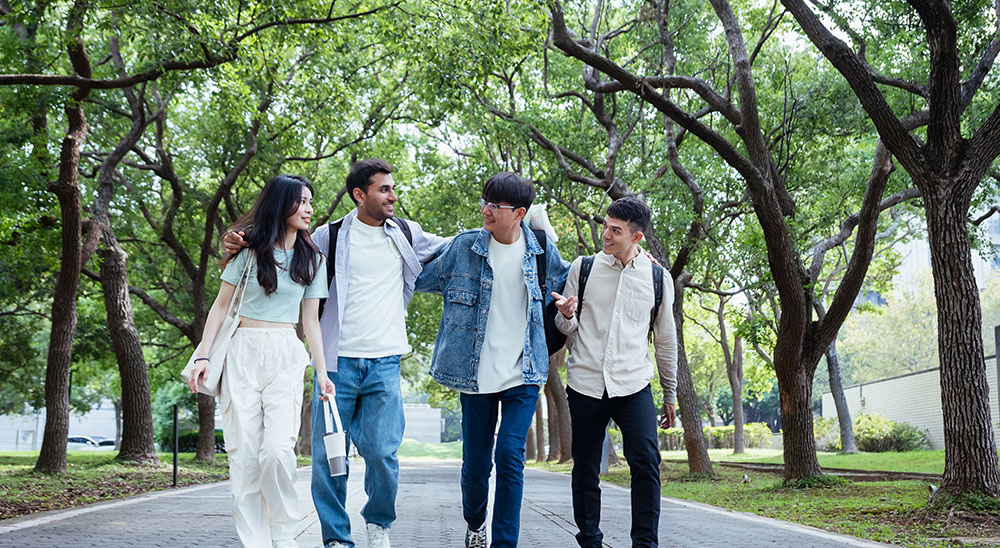
❝ I chose NCU because of their scholarship program for international students as well as the environment and facilities they offer for students to use. Aside from that, NCU is one of the top universities in Taiwan where a lot of top academic research had been published.❞ —Dick Hansel Ryan (Indonesia) International Graduate Program in Artificial Intelligence at National Central University
❝ The distinguished faculty and their contributions to cutting-edge research were significant factors in my decision of choosing National Chung Cheng University.❞ —Ergu Yared Abera (Ethiopia) PhD program in Computer Science and Information Engineering at National Chung Cheng University



![[FICHET Higher Ed in Taiwan Newsletter] Taiwan's AI Revolution: Bridging Academia and Industry](/album/news/84f9ed7291f11db49515c4b0w1200.webp)
![[FICHET Higher Ed in Taiwan Newsletter] Taiwan's AI Revolution: Bridging Academia and Industry](/album/news/84f9ed7291f11db49515c4b0w500.webp)
![[Forward News] Taiwan expands INTENSE Program eligibility to attract foreign talent](/assets/img/default_cover.webp)