
As 2025 draws to a close, Taiwan is accelerating its effort in transitioning to a circular economy and net-zero future. In this issue, we look at Taiwan's green industry and the NT$10 billion Taiwan Green Growth Fund that are forging the workforce of tomorrow. We also take a look at Taiwan's education outreach, both in Mandarin education and in connecting with Nobel laureates. Lastly, how schools and companies are working together to streamline job placements through the INTENSE program.
Taiwan's Green Economy Roadmap
Circularity and NT$500 Billion Value

Student at National Chengchi University's (NCCU) expansive library. Photo: FICHET
Following Taiwan President Lai Ching-te's remark in the fifth National Climate Change Committee meeting, which highlighted an NT$500 billion in value (USD$16.67 billion, accounting for 2% of GDP) added to Taiwan green technology industry in 2024, the Ministry of the Environment (MOENV) unveiled the draft Taiwan Circular Economy Roadmap at the 2025 Asia Pacific Circular Economy Roundtable & Hotspot event. This roadmap outlines an action framework of how Taiwan will integrate policy, the business sector, and financial tools to advance from resource recycling toward a circular economy system.
Critical Materials and Energy Infrastructure
One of the priority sectors that the roadmap identifies is energy infrastructure and critical materials, for which National Central University's College of Sustainability and Green Energy provides a comprehensive set of programs. The college's cross-disciplinary programs include leadership in sustainability, carbon reduction, and green energy engineering, and they are designed to train solution-oriented professionals who can solve multifaceted problems.
Sustainable Urban Development in Taipei
The roundtable event's host city, Taipei, also prioritizes sustainable urban development, with the University of Taipei—the city's think tank—houses a School of Urban Studies that offers programs exploring urban sustainability issues. The curriculum draws on Taipei's policies and practices and focuses on implementing net-zero emissions, building climate-resilient cities, advancing the circular economy, and promoting sustainable inclusion.
The Role of Circular Sustainability Education
Another focus of the roundtable event is circular sustainability education, which is emerging as a pivotal force driving the circular economy and sustainable lifestyle transition. National Taiwan Normal University's Institute of Sustainability Management and Environmental Education has special expertise in this field. The institute has faculty specializing in a wide range of sustainability education topics, and its programs explore innovative approaches to reshape societal habits and values towards sustainability.
Financing the Transition
The roundtable also addressed financial instruments, covering topics such as green finance, circular accounting and value measurement, reverse supply chains, as well as digital technology and traceability. National Chengchi University's Center for Business Sustainability addresses such topics and provides business consultation. The center draws expertise from faculty members in accounting, business management, and risk management, who then bring back first-hand knowledge to provide practical training aligned with industry needs to students.
The Green-Collar Revolution
Meeting the Demand for Net-Zero Talent
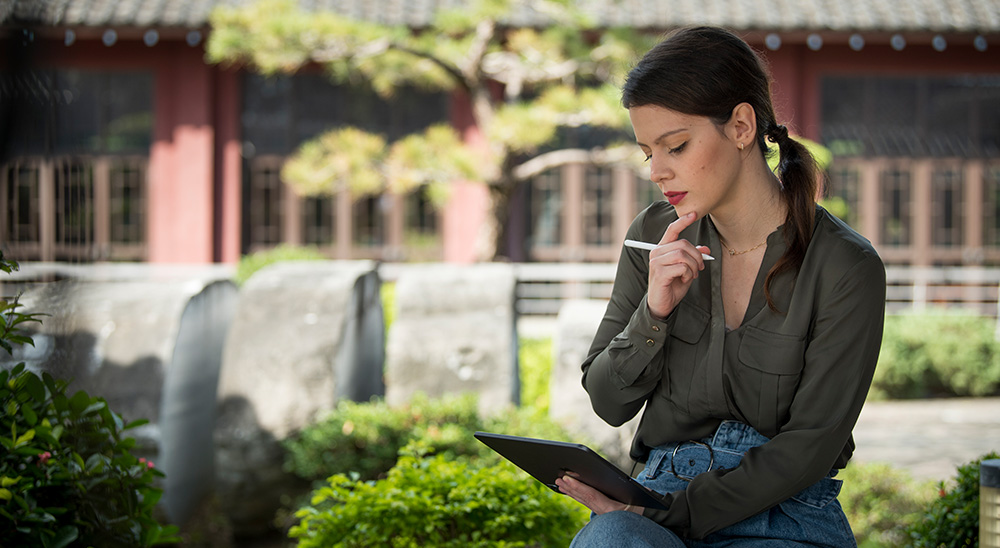
An international student of Tamkang University (TKU). Photo: FICHET
In May 2025, MOENV announced an NT$10 billion Taiwan Green Growth Fund that aims to work with the business sector to establish a net-zero ecosystem and create green-collar job opportunities. Demand for “green” talent has seen growth similar to AI or semiconductor sectors, with over 22,000 monthly job openings in 2024 according to an MOENV report. To address this, MOENV is also partnering with 28 universities, including Tamkang University, to establish the Net-Zero Green Collar Education Alliance. This initiative offers courses in greenhouse gas management, carbon footprint verification, and green finance, providing pathways to professional certification.
Integrating the Ocean
Research and Resilience in Taiwan's Green Transition
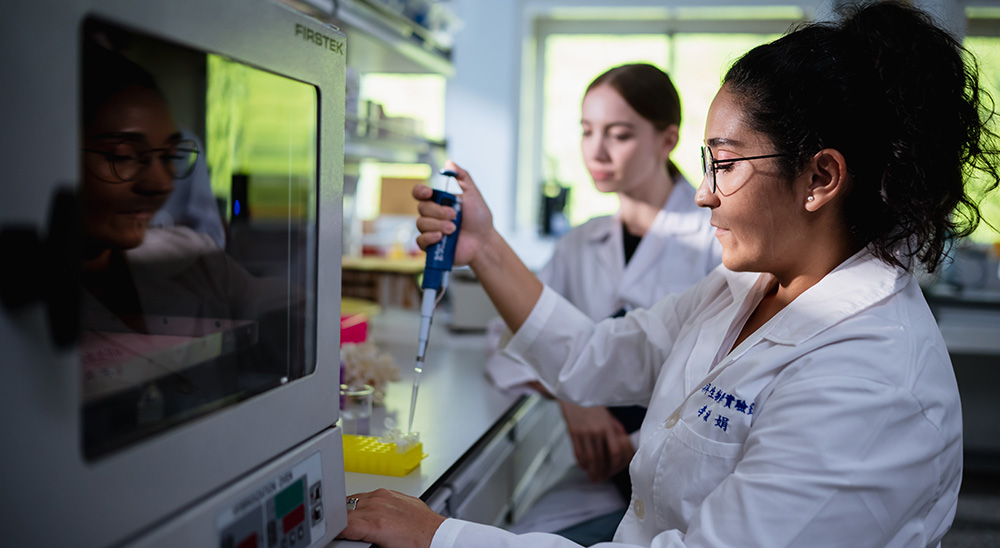
Marine biotechnology researchers at National Sun Yat-sen University (NSYSU). Photo: FICHET
Taiwan is actively integrating ocean resilience into its national green transition, and National Sun Yat-sen University's College of Marine Science, one of Taiwan's most comprehensive marine research institution, is at the forefront of the research and applications in building this resilience. With programs in marine biotechnology, ecological conservation, resource studies, and environmental engineering, the college stands to benefit from the Ocean Affairs Council's recent substantial increase in research funding for projects spanning marine conservation, sustainable development, and smart ocean technologies.
Collaborative Training
High-demand Jobs Guaranteed Through INTENSE
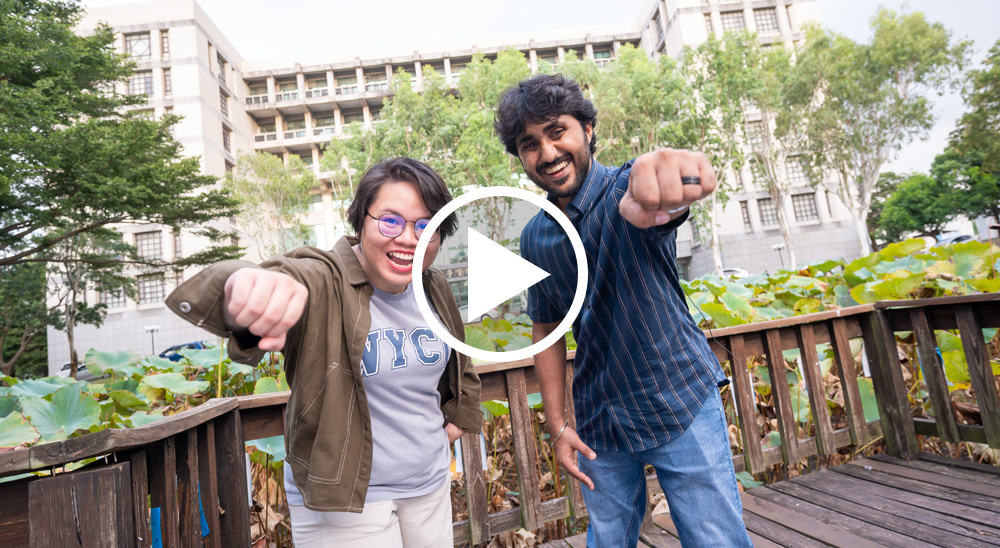
INTENSE students at National Yang Ming Chiao Tung University (NYCU) give their testimonials. Photo: FICHET
INTENSE (International Industrial Talent Education Special Program) is a Taiwanese scholarship that strategically partners the government, universities, and major tech companies like TSMC and NVIDIA. The primary benefit for students is a comprehensive package that includes full financial support (tuition, airfare, and a monthly stipend). Most importantly, it provides two years of specialized training in high-demand fields (e.g., semiconductors and AI) and guarantees at least two years of work experience with the sponsoring multinational corporation immediately upon graduation. Liaison offices ("INTACT Base") have been set up around the world to intensify the outreach of this program.
National Yang Ming Chiao Tung University is one of the institutions offering INTENSE programs. Partnering with Micron, renowned computer memory manufacturer, the university brings students hands-on experience and prepare them for real careers in tech through its INTENSE program. Here is what the students are saying about the program.
❝ The INTENSE Program’s targeted focus on semiconductor technology and its direct relevance to industry needs were key factors in my decision. ❞ —Vineeth Jacob (India)
❝ I chose NYCU because of its strong partnership with Micron through the INTENSE program. It's not just theory here—we get hands-on experience and even internship and job opportunities. It's a solid bridge between academia and the real tech world. ❞ —Phan Thi Kim Ngan (Vietnam)
Mandarin Soft Power
The Push for Taiwan's Mandarin Education
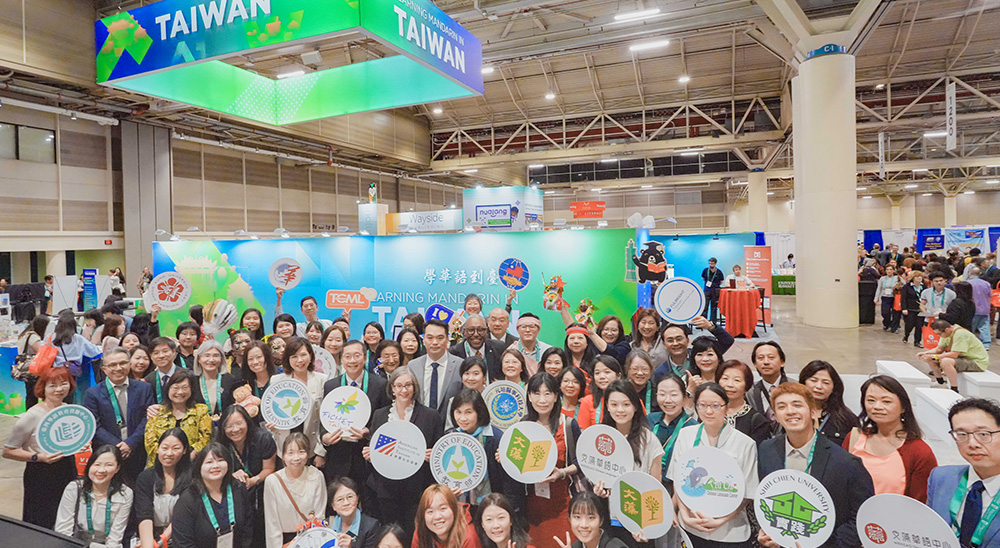
The Taiwan Pavilion at the 2025 ACTFL Annual Convention. Photo: FICHET
Taiwan–U.S. Partnership Advances Mandarin Education at 2025 ACTFL Convention
In November, FICHET led a delegation of 17 institutions, including the National Palace Museum and National Center for Traditional Arts, to the 2025 ACTFL Annual Convention in New Orleans. The Taiwan Pavilion at the event showcased cultural heritage integrated with Mandarin education, providing an immersive learning experience that drew strong interest from American educators. FICHET also organized the Taiwan-U.S. Mandarin Education Exchange Forum, where representatives from the U.S. Department of State, AIT, NCSSFL, and numerous language education experts engaged in extensive discussions on Mandarin teaching resources, faculty exchanges, and collaborative curriculum development. Currently, the Taiwan Huayu BEST Program, under the U.S.-Taiwan Education Initiative, has established partnerships between 23 Taiwanese and 79 American universities, with seven Mandarin Learning Centers across the U.S.
Welcoming Student through Mandarin Scholarships
In October 2025, the Ministries of Education and Foreign Affairs held an orientation and welcome ceremony for new recipients of the Taiwan Scholarship and the Huayu Enrichment Scholarship, which were awarded to 1,500 students from more than 80 countries this year. In their 21st year, the two scholarship programs are designed to encourage international students to pursue degrees or study Mandarin in Taiwan. The education ministry also encourages these students to leverage their multilingual and multicultural advantages to pursue employment opportunities in Taiwan after graduation. Information on the Huayu Enrichment Scholarship is announced by overseas missions by January 31 each year. Scholarships of varying durations are available annually.
Event Radar
31 Nobel Laureates Head to Taipei
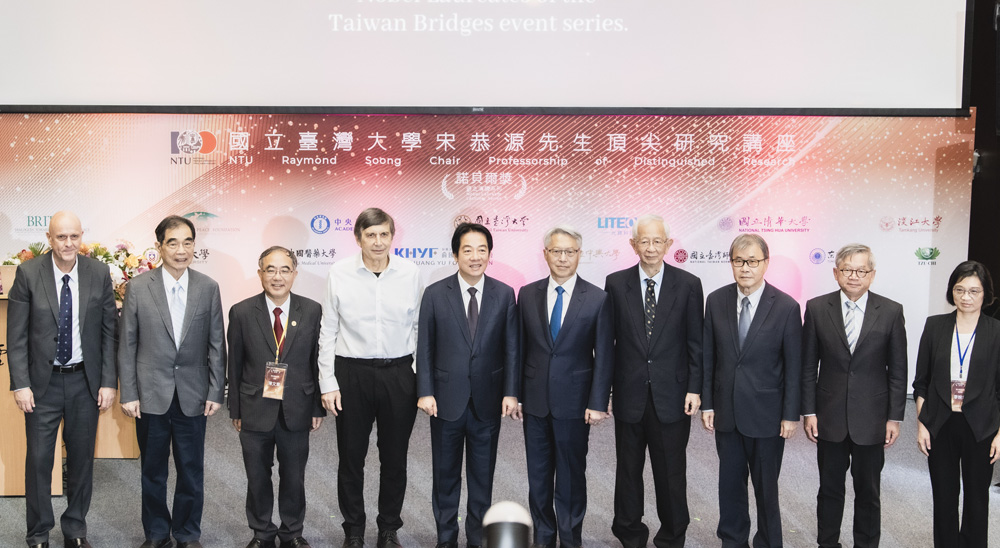
President Lai Ching-te presided over the launch of Taiwan Bridges. Photo: Academia Sinica
To promote in-depth exchanges between Taiwan and the world's leading academic circles, the Taiwan Bridges Program—jointly initiated by the Academia Sinica and 12 domestic academic and research institutions—launched in November 2025. From 2025 to 2026, the program will invite 31 Nobel laureates to Taiwan for a series of lectures and academic exchanges, thereby fostering dialogues between Taiwan and the global scientific community. The program was proposed by Taiwanese Nobel Chemistry winner Lee Yuan-tseh to bridge nations, disciplines, and minds. Academia Sinica President James C. Liao emphasized promoting science for global benefit. Physicist Andre Geim, 2010 Nobel Physics laureate, delivered the inaugural keynote on graphene research.
FICHET & Study in Taiwan
QS Summit, Sustainability Connection, and Southeast Asian Outreach
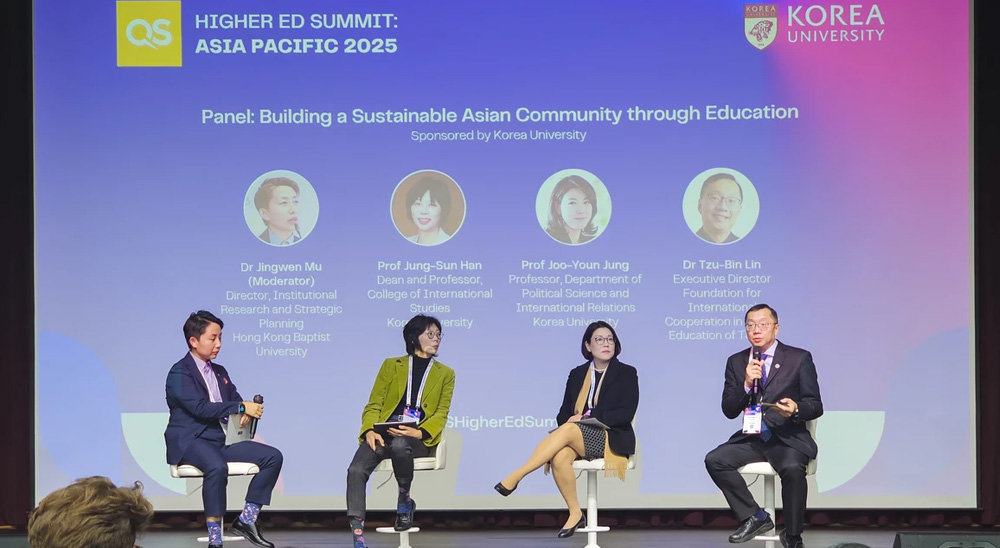
FICHET director Dr. Tzu-Bin Lin (right) at the 2025 QS Higher Ed Summit. Photo: FICHET
In November 2025, FICHET participated in the QS Higher Ed Summit: Asia Pacific 2025 in Seoul, themed "Advancing Generational Potential." Executive Director Professor Tzu-Bin Lin joined a panel on "Building a Sustainable Asian Community through Education," discussing Taiwan's role in international talent cultivation and sustainable education. The 2026 QS rankings were also announced at the event, with several Taiwanese universities rising in ranking in the QS Asia rankings and Sustainability rankings, boosting Taiwan's higher education visibility.
Lin also attended the Taiwan-UK University Consortium Annual Meeting held at the University of Edinburgh in Scotland in October. Representatives and scholars from a total of eight allied universities across Taiwan and the UK engaged in exchanges on issues such as bilingual education and net-zero sustainability, continuing to advance scientific research cooperation and higher education partnerships.
Also in October, FICHET partnered with BMI Globaled to promote "Study in Taiwan" at education fairs in Hanoi and Ho Chi Minh City, targeting elite Vietnamese students in semiconductors, medicine, and STEM fields while conducting high school visits to explore cooperation opportunities.
Seasonal Greetings

As 2025 draws to a close, FICHET extends warm wishes for a joyful holiday season and a prosperous New Year. We thank our partners, universities, and international education communities worldwide for your support throughout this remarkable year. May 2026 bring continued success, meaningful partnerships, and new opportunities for advancing global higher education together. Merry Christmas and Happy New Year!
We hope you found the content of this edition helpful. If you have any suggestions or comments, please let us know by writing us at fichet@fichet.org.tw. We appreciate your interest in Taiwan's higher education.
From Our Students
Short Film Contest highlights Taiwan's Appeal to International Students
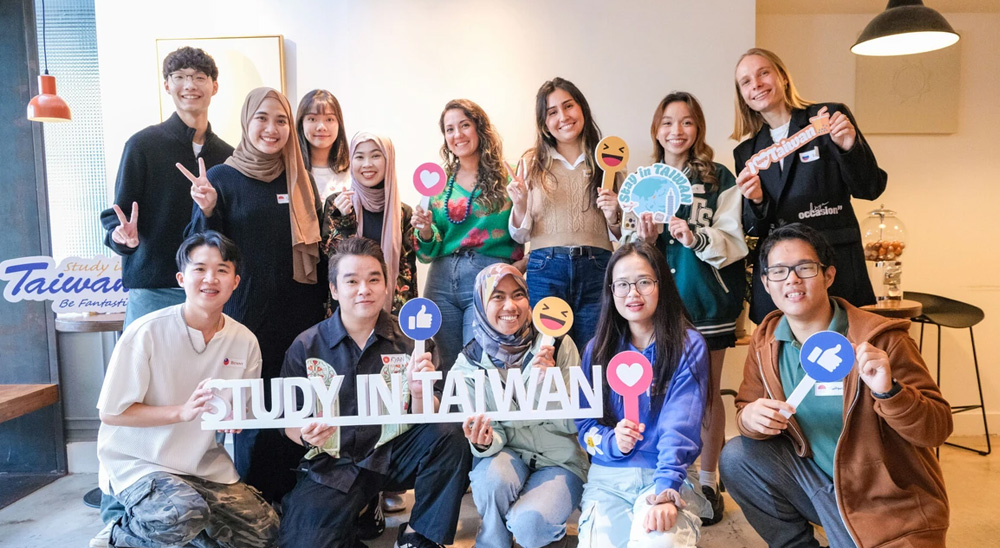
Winners of the 2025 Study in Taiwan: My Campus Diary Short Film Contest. Photo: FICHET
In the recent FICHET-hosted 2025 My Campus Diary Short Film Contest, we saw entries that highlighted Taiwan's friendly and diverse learning environment through the lense of international students. The Study in Taiwan website provides more such stories, as well as information on Taiwan’s advantages, key numbers, degree programs, scholarships, and living in Taiwan.
❝ Receiving this scholarship represented not only financial support, but also an important vote of confidence in my academic and professional potential. ❞ —W. J. Galeano Aunt (first-prize winner, Colombia), MA in International Human Resource Development at National Taiwan Normal University.
❝ The scholarship opportunity through the Outstanding International Graduate Student Scholarship was also significant. It validated my previous achievements and made it financially feasible to pursue this dream. ❞ —S. Rahmania Ala (second-place winner, Indonesia), MBA at National Taiwan University.
❝ Another factor influencing my decision is the availability of scholarships from the Ministry of Education (MOE) and Chang Gung University. ❞ —H. S. Firdausi (third-place winner, Indonesia), International Master Degree Program for Molecular Medicine in Emerging Viral Infection at Chang Gung University.



![[FICHET Higher Ed in Taiwan Newsletter] Taiwan Going Green and Circular](/album/files/c859324572bdc94694075daew1200.webp)
![[FICHET Higher Ed in Taiwan Newsletter] Taiwan Going Green and Circular](/album/files/c859324572bdc94694075daew500.webp)
![[Forward News] 𝐈𝐍𝐓𝐄𝐍𝐒𝐄 𝐏𝐫𝐨𝐠𝐫𝐚𝐦𝐬 (International Industrial Talents Education Special Program)](/album/files/97160f98980cabe554243950+cw500h280.webp)
![[Forward News] MOE Short Term Research Award](/album/news/6697338f86479+cw500h280.webp)
![[FICHET Higher Ed in Taiwan Newsletter] Flying High in Higher Ed: Taiwan's Unmanned Revolution](/album/files/c859324572bdc94694075dae+cw500h280.webp)

![[Forward News] TSMC fab in Japan attracts semiconductor students to Taiwan](/assets/img/default_cover.webp)

