
Welcome to the March 2026 Taiwan Higher Education Newsletter. While the world often views Taiwan through the lens of microscopic components, our university campuses are focused on technology in perpetual motion: the unmanned systems revolution. From drones inspecting renewable energy grids to sounding rockets touching the atmosphere, this issue explores how Taiwan is building and piloting the physical vehicles of tomorrow.
Sky, Sea, and Space
Autonomous Frontiers
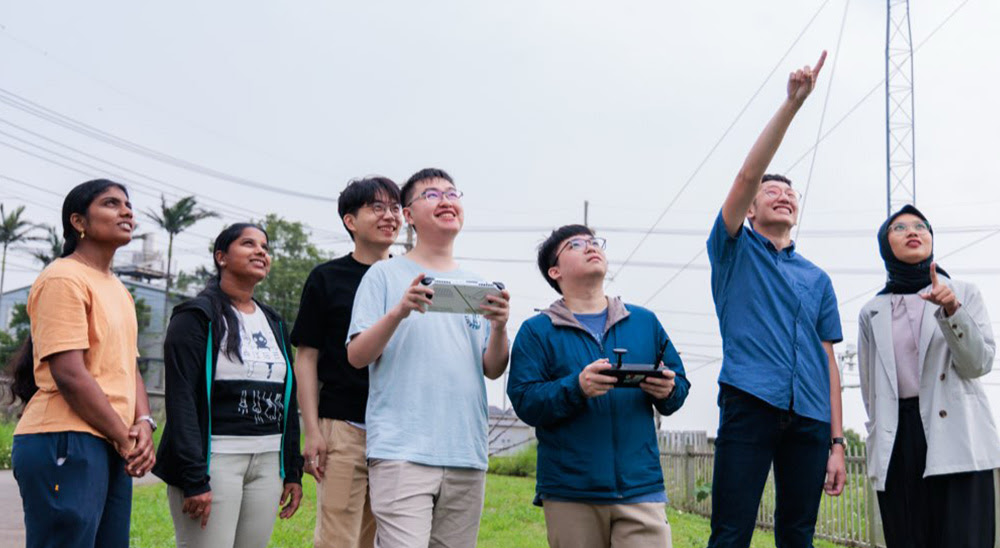
Dick Hansel Ryan and fellow students from Nt'l Central U (NCU) testing drones. Photo: FICHET
The frontier of modern mobility is defined by the seamless integration of machines into every corner of the physical world. Taiwan’s universities are pushing autonomous tech from the deep sea all the way to the edge of space.
Reaching toward the stars, Tamkang University (TKU) recently made history by launching the TKU-II sounding rocket to an altitude of over 7 kilometers, a record for Taiwan's private institutions. This milestone was the direct result of TKU's hands-on aerospace engineering curriculum, which puts students in the driver's seat to design active propulsion and telemetry systems. International applicants can literally trade the classroom for the launchpad by joining TKU’s Department of Aerospace Engineering to design, build, and fly advanced unmanned systems from scratch.
Closer to earth, unmanned systems are tackling high-stakes infrastructure maintenance. At National Central University (NCU), a student team recently took center stage at a national college smart innovation competition, showcasing an AI-driven drone equipped with ultrasonic sensors designed specifically to inspect wind turbine blades. This hands-on field deployment perfectly bridges lab research with industrial application, a core philosophy of NCU’s INTENSE Master in Advanced Mechanical Engineering.
To control these complex flying machines more intuitively, National Yang Ming Chiao Tung University (NYCU) is dissolving the pilot-machine boundary with wearable gesture-control systems. Students ready to master the underlying digital architecture of these AI interfaces can launch their careers through NYCU’s INTENSE International Semiconductor Talents Program.
Finally, true autonomy requires navigating unforgiving environments without a safety net. National Sun Yat-sen University (NSYSU) has solved underwater GPS-independent positioning using a groundbreaking silicon photonic gyroscope chip. Prospective students can engage directly with the marine technology and power systems sustaining this deep-sea innovation via the TEEP internship in Efficient Electric Power Conversion. Whether you are navigating the ocean floor or launching into the stratosphere, Taiwan provides the ultimate proving ground to turn theoretical physics into boundless exploration.
Beyond the Assembly Line
Intelligent Machines That Think and Adapt
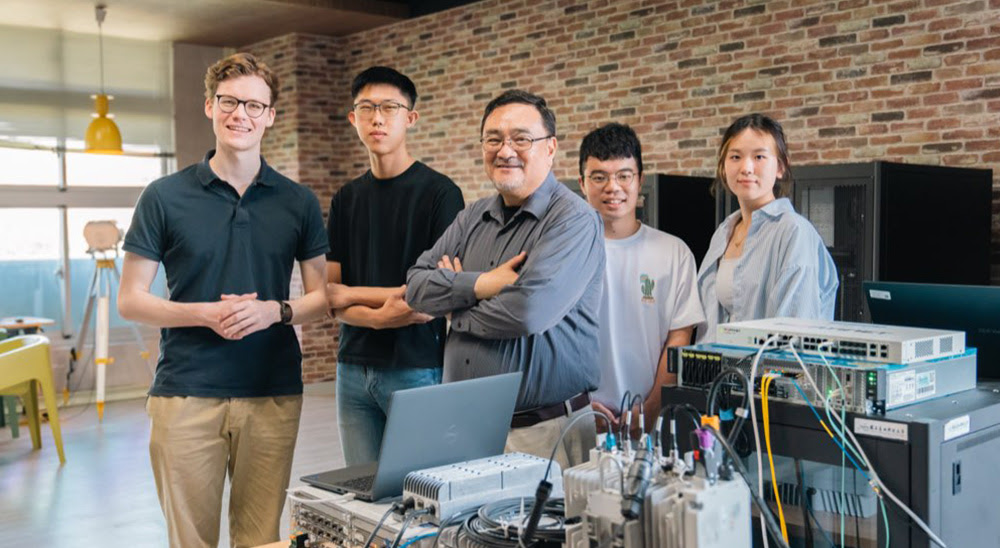
Robert Ahr with professor and fellow electrical engineering students at Taipei Tech (NTUT). Photo: FICHET
The next generation of unmanned systems isn't just about raw power—it's about building cognitive ecosystems. Today’s machines need to learn, react, and adapt in real-time. By embedding sophisticated AI right into the core hardware, Taiwan’s universities are transforming static assembly lines into perceptive, quick-thinking partners capable of high-stakes, autonomous decisions.
Check out the academic pathways engineering this new era of machine intelligence:
- Cheng Shiu University (CSU)
Focus: Extreme Environment Hardware
Key Innovation: Co-developed a Light Remote-Controlled Combat Vehicle for explosive ordnance disposal.
Program of Interest: INTENSE Program in Precision Design and Manufacturing
- Feng Chia University (FCU)
Focus: Autonomous Validation
Key Innovation: An aerospace engineering team showcased a fully autonomous flight system built to flawlessly navigate GPS-denied environments at the 2025 National Defense UAV Challenge.
Program of Interest: INTENSE Master in Mechanical and Computer-Aided Engineering
- National Taipei University of Technology (NTUT, Taipei Tech)
Focus: Platform Architecture
Key Innovation: Built the TSMC-validated, 5G-ready AI Wings platform for open, scalable innovation.
Program of Interest: TEEP Internships in Semiconductor Materials and Optoelectronic Device Application
- National Taiwan University of Science and Technology (NTUST, Taiwan Tech)
Focus: Hardware Efficiency
Key Innovation: Developed a neural network accelerator that boosts UAV flight times by 43%.
Program of Interest: INTENSE Master in Intelligent Manufacturing Technology
In Taiwan, you aren’t just studying the future of robotics—you are building it. Our universities offer a direct launchpad to turn your academic potential into industrial mastery.
Resilient Autonomy
Systems that Navigate, Survive, and Protect
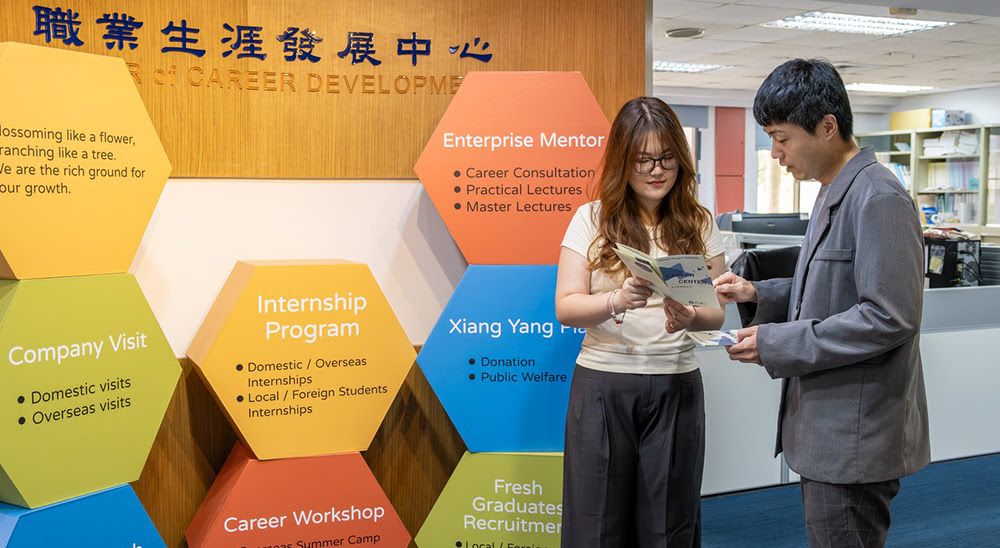
Nt'l Chengchi U (NCCU) is committed to int'l students' career development. Photo: FICHET
- National Chengchi University (NCCU): Pushing the envelope on strategic survival, NCCU is developing AI-driven visual navigation that lets drones hover with precision and execute autonomous swarm reconnaissance—all entirely without GPS. Pioneered by a cross-disciplinary crew at the Computer Science Department, this tech is already being deployed alongside businesses for high-stakes disaster response.
- National Tsing Hua University (NTHU): Taking low-power robotics to the next level, NTHU developed a biomimetic AI chip inspired by fruit flies. The result? Drones that can dodge obstacles in real-time while using 90% less power. Students can get their hands on this Nature Electronics-featured innovation through the INTENSE Master in International Semiconductor and IC Design.
- National Taiwan University (NTU): Autonomy is also about keeping the skies safe. NTU is bridging the gap between cutting-edge research and national security by partnering with NCSIST to launch a massive NT$30 million fund for counter-drone innovators. You can tap into this elite defense and commercial ecosystem through their INTENSE STEM Master and PhD programs to help build the future of aerospace security.
- National Cheng Kung University (NCKU): For machines to truly think independently, they need to keep flying when signals drop. NCKU’s iUAS Lab pioneers fixed-wing UAVs that can autonomously spot runways and land safely even in completely GPS-denied zones. International students can master the complex hardware making this possible through NCKU’s diverse INTENSE programs across mechanical, material, and electrical engineering.
By mastering these resilient technologies, you don't just study machines—you become the architect of autonomous systems built to survive and thrive in the world’s most demanding environments.
Sustainable Skies
Engineering Eco-Autonomy
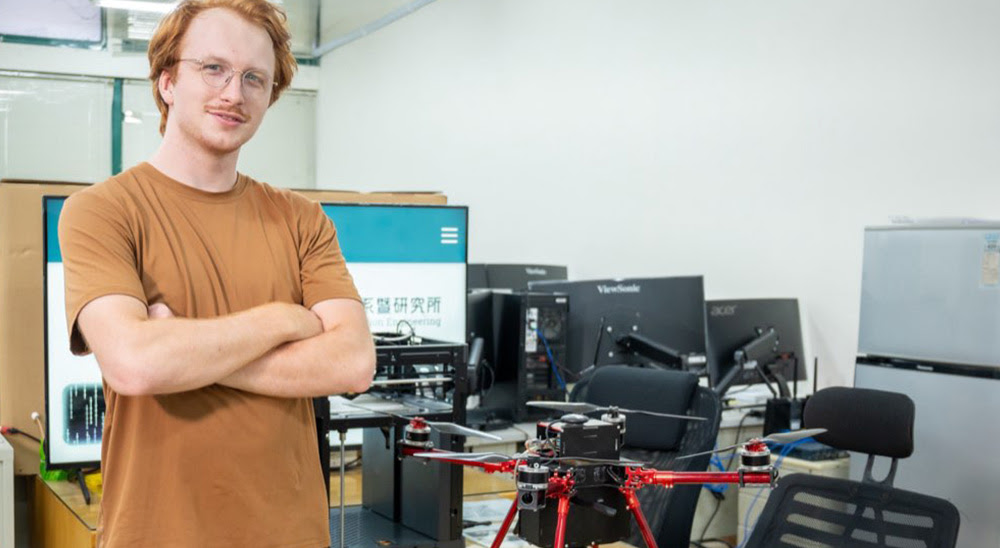
Vytaras Juraska, a computer science student at Nt'l Dong Hwa U (NDHU). Photo: FICHET
The true test of any new technology is how it impacts the world around us. In Taiwan, autonomous systems are breaking out of the lab and heading straight into rice paddies, coastal reefs, and wind farms. By deploying smart drones to monitor crop health, track environmental changes, and protect biodiversity, our universities are proving that the future of high-tech innovation goes hand-in-hand with natural sustainability.
- Ming Chi University of Technology (MCUT)
Sustainability Focus: Circular Hardware Design
Key Innovation: Designed the Munin drone using 100% recyclable composite materials modeled on bird bone structures.
- National Chung Hsing University (NCHU)
Sustainability Focus: Precision Agriculture
Key Innovation: Integrates UAV multispectral imagery and machine learning to optimize rice nitrogen fertilization with 90% accuracy.
- National Dong Hwa University (NDHU)
Sustainability Focus: Ecological Monitoring
Key Innovation: Operates Taiwan’s first eastern drone certification center for environmental oversight and training.
- National Kaohsiung Normal University (NKNU)
Sustainability Focus: Coastal Monitoring
Key Innovation: The Department of Geography applies UAV photogrammetry and 3D surface modeling to monitor dynamic coastal evolution.
- Tunghai University (THU)
Sustainability Focus: Computational Control
Key Innovation: The Department of Smart Computing and Applied Mathematics develops combined sensing, positioning, and decision control systems for autonomous drones.
The Human Factor
Building the Autonomous Revolution Workforce
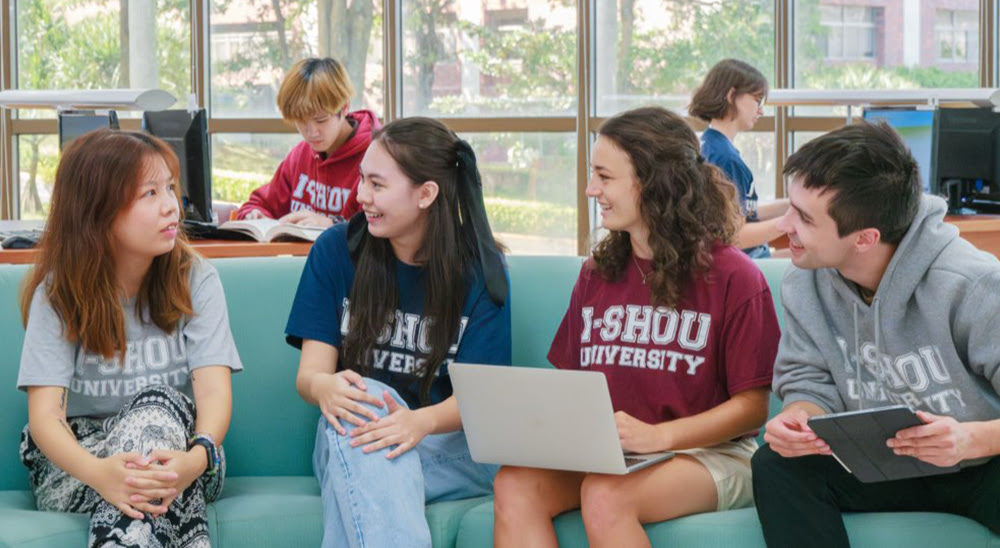
International students at I-Shou University (ISU). Photo: FICHET
The most advanced unmanned systems in the world are only as brilliant as the people who design, pilot, and maintain them. Taiwan’s universities aren't just building drones; they are actively spearheading a national effort to build a comprehensive, world-class talent pipeline.
This interconnected academic ecosystem turns theory into immediate practice. Over at I-Shou University (ISU), the College of Intelligent Science and Technology is getting students hands-on with UAV surveillance systems right inside their Smart Robot Laboratory. You can fast-track your career straight into these practical applications through ISU’s INTENSE post-baccalaureate programs in equipment and mechanical engineering.
This solid laboratory foundation translates into practitioner-level expertise at National United University (NUU), which operates a dedicated UAV lab and offers professional drone pilot certifications that align directly with national policy. Finally, National Taiwan Normal University (NTNU) is shaping the early-stage robotics pipeline, eagerly welcoming global innovators through TEEP internships focused on using deep learning-based intelligent video surveillance to tackle real-world security challenges.
Cultural Fluency
Your Passport to Taiwan's Autonomous Hub
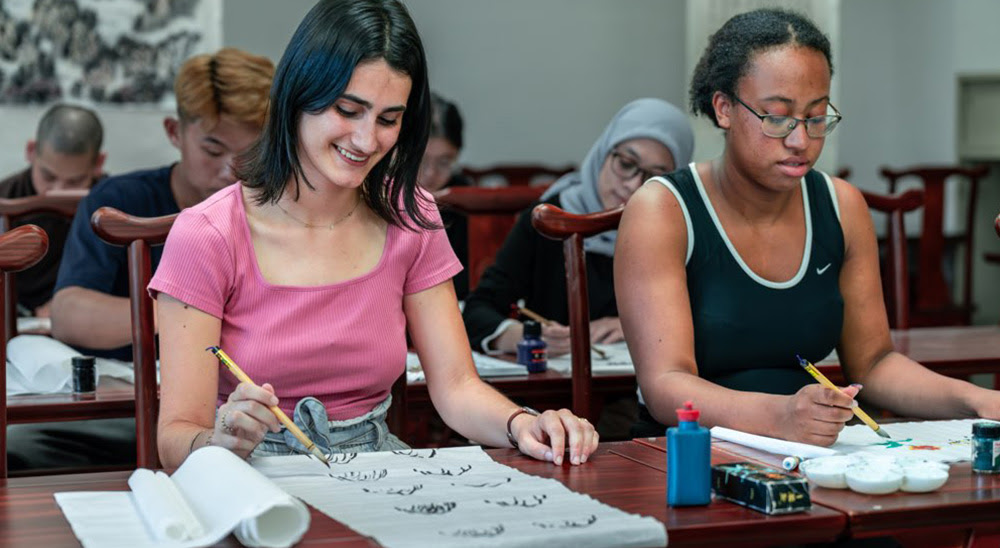
Elisa Duquet of the University of Taipei (UTaipei) in a culture experience class. Photo: FICHET
Taiwan’s technical ambitions might be reaching the stratosphere, but the true foundation of all this innovation is communication. For international students, tapping into one of the world’s most sophisticated tech ecosystems often starts with a single word. Mastering Mandarin is the ultimate "soft skill" that unlocks Taiwan's hard tech opportunities.
Looking for a scenic change of pace from the bustling capital? Fo Guang University (FGU) is a premier gateway for language study. As a certified host for the Huayu Enrichment Scholarship, FGU offers a monthly stipend of NT$25,000 to help you master Mandarin—all while you dive into cutting-edge UAV task scheduling research. It’s the perfect blend of deep linguistic immersion and smart-campus tech, making it an ideal launchpad for global talent.
If city energy is more your speed, the University of Taipei (UTaipei) embeds you right in the beating heart of Taiwan’s strategic center. As a major hub for internationalization, UTaipei is the place to be if you want to see exactly where urban resilience meets high-level global policy. It offers a world-class academic environment designed to ensure you graduate not just technically prepared, but fully culturally integrated.
Scholarship Opportunities
Expanding Taiwan’s Academic Network
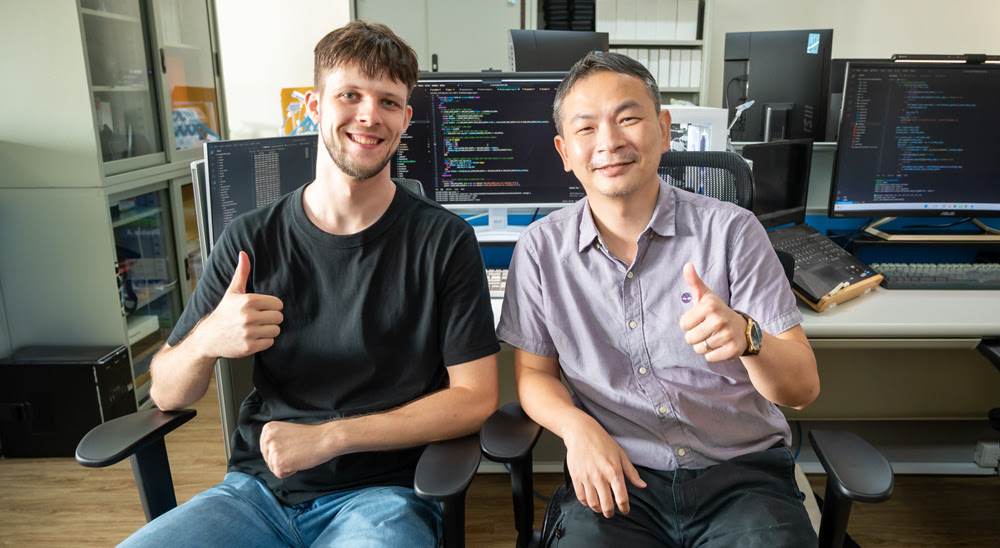
Lithuanian student Mantas Sabaliauskas is an electrical engineering student at Nt'l Sun Yat-sen U (NSYSU). Photo: FICHET
In the first quarter of 2026, Taiwan seriously leveled up its international scholarship game, aligning our talent pipeline directly with the world's most urgent technological and sustainability needs. Here is a breakdown of the primary scholarship pathways currently shaping Taiwan’s global educational outreach:
The Taiwan-Europe Scholarship (TES) Program
Administered by the TaiwanICDF, this newly revamped framework welcomes young European talent by rolling previous connectivity and semiconductor programs into one highly streamlined pathway.
- TES Tech Degree Program
Target Demographics: Students from the Czech Republic, Slovakia, Lithuania, and Poland.
Academic Offering: Full English-taught Master's or Doctoral programs in advanced STEM fields at seven elite universities.
- TES Connectivity/Exchange Program
Target Demographics: European exchange students, specifically targeting third- and fourth-year science and technology students from Czechia, Slovakia, Lithuania, and Poland.
Academic Offering: Degree or non-degree research-heavy exchanges at 20 partnering higher education institutions.
- TES Semicon Training Program
Target Demographics: Students and professionals from Czechia, Slovakia, Poland, Lithuania, Italy, and Bulgaria.
Academic Offering: Specialized courses designed by leading semiconductor research organizations and higher education institutions.
The Taiwan Scholarship for Diplomatic Allies
Under the Diplomatic Allies Prosperity Project, the government is actively scaling up support for students from formal diplomatic ally nations, seamlessly blending educational backing with tangible national development. For the 2026-2027 academic year, the program is increasing its Taiwan Scholarship recipients from 400 to 500. The ultimate goal? Equipping students with highly practical skills in high-impact fields like smart agriculture and sustainable tourism to drive real-world career success.
FICHET & Study in Taiwan
Expanding Taiwan’s Global Academic Footprint
As Taiwan continues to pioneer the future of autonomous systems and high-tech innovation, the Foundation for International Cooperation in Higher Education of Taiwan (FICHET) is working behind the scenes to build the global partnerships that make it all possible.
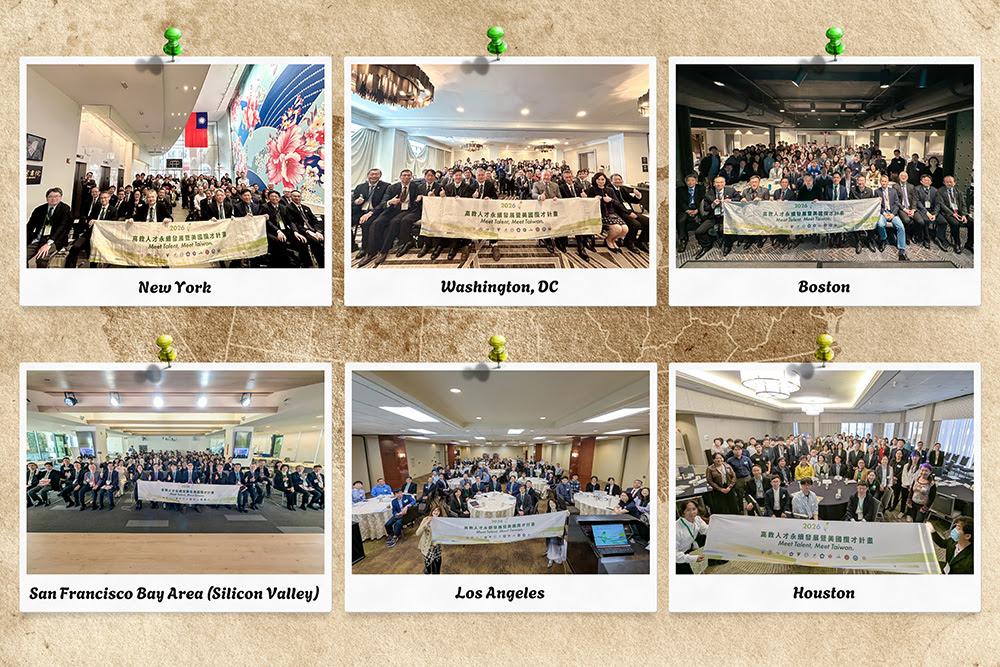
2026 "Meet Talent, Meet Taiwan!" events in the US. Photo: FICHET
US Recruitment for Elite International R&D Talent: Organized by the Ministry of Education and hosted by FICHET, this landmark initiative (February 27–March 5, 2026) was all about bringing top-tier global minds to Taiwan. Leadership from 12 of our top domestic universities hit the road, touring six major U.S. cities—including New York, Washington D.C., and San Francisco—to conduct on-site interviews for over 150 academic roles. To land the absolute best experts in AI, semiconductor tech, and green energy, the program rolled out unprecedented compensation packages, including highly competitive initial signing and retention bonuses.
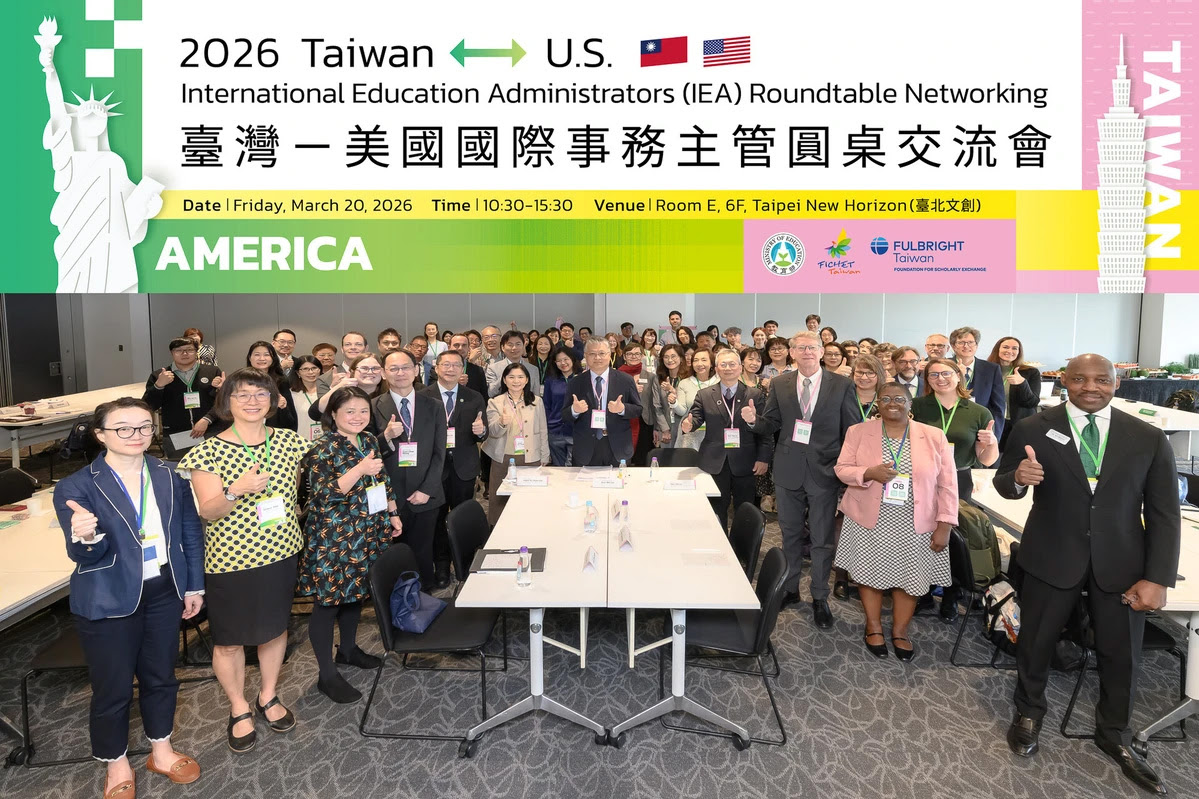
Participants of the 2026 Taiwan-U.S. IEA Rountable Networking. Photo: FICHET
Taiwan-U.S. International Education Administrators (IEA) Roundtable Networking: Co-organized by FICHET and Fulbright Taiwan on March 20, the event united nearly 70 higher education leaders from 43 Taiwanese and 16 U.S. universities. Deputy Education Minister Liu Kuo-Wei celebrated over 2,000 active academic agreements and robust student exchanges—including 4,000 Americans currently studying in Taiwan. Guided by a new three-year strategic plan, both nations are actively deepening two-way talent pipelines and expanding critical collaborations in AI, semiconductors, and sustainable development.
Q2 2026 Events Preview
Looking ahead, FICHET is gearing up for a packed schedule of international engagements to keep Taiwan at the absolute center of global educational exchange. Mark your calendars for these upcoming Q2 events:
May
- National Conference for Directors of Mandarin Language Centers in Higher Education
- U.S.-Taiwan Higher Education Networking
- May 26–29: NAFSA Annual Conference & Expo
June
- 2026 Taiwan-Canada Virtual B2B Partnership Development Event
- International Admission Workshops (Vietnam & Indonesia)
From Our Students

“The PhD program at Taiwan Tech is well-structured, offering the independence of research in both topic and execution.”
—Moritz Sontheimer (Germany 🇩🇪)
Mechanical Engineering, National Taiwan University of Science and Technology
“Tamkang University may offer state-of-the-art laboratories and research centers for mechanical engineering students to gain practical experience.”
—Chandrashekhar Tasupalli (India 🇮🇳)
Mechanical and Electro-Mechanical Engineering, Tamkang University



![[FICHET Higher Ed in Taiwan Newsletter] Flying High in Higher Ed: Taiwan's Unmanned Revolution](/album/files/c859324572bdc94694075daew1200.webp)
![[FICHET Higher Ed in Taiwan Newsletter] Flying High in Higher Ed: Taiwan's Unmanned Revolution](/album/files/c859324572bdc94694075daew500.webp)
![[Forward News] 𝐈𝐍𝐓𝐄𝐍𝐒𝐄 𝐏𝐫𝐨𝐠𝐫𝐚𝐦𝐬 (International Industrial Talents Education Special Program)](/album/files/97160f98980cabe554243950+cw500h280.webp)
![[Forward News] MOE Short Term Research Award](/album/news/6697338f86479+cw500h280.webp)

![[Forward News] TSMC fab in Japan attracts semiconductor students to Taiwan](/assets/img/default_cover.webp)

