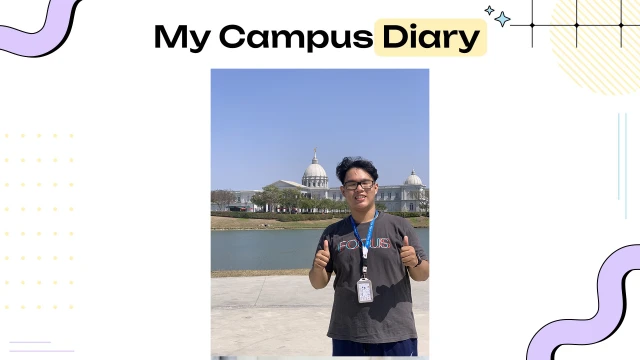
I was raised in an agricultural family; my father is an officer under the Ministry of Agriculture and Cooperatives, and my mother runs her own farm. I spent much of my childhood helping my mother with farming. During my free time, especially at night, I enjoyed watching football. Most of my club friends went to technical school after junior high, but I aimed for something bigger and continued to senior high school, eventually attending the biggest engineering school in Thailand, King Mongkut’s Institute of Technology Ladkrabang. I earned both my bachelor’s and master’s degrees in engineering there. My first time abroad was during my master’s, where I attended a conference in South Korea and received a JASSO scholarship as an exchange student in Japan. A fun fact about me: I thought my nickname was Nik, but it’s actually Nics, derived from Newly Industrialized Countries, a name I only discovered the meaning of when I was in Taiwan. This is perhaps why I’ve always been drawn to engineering.
Decision to Study in Taiwan
Initially, I planned to do my Ph.D. in Thailand. However, after completing my master’s and working on a freelance project, I became interested in studying in Taiwan, influenced by a crush I had on a girl who graduated from there. The Hsinchu Science Park, inspired by Silicon Valley, was also a significant reason for my choice. I saw it as an opportunity to work among top-tier companies and improve myself by learning from successful people. As the big fan of football, I always see players moving to different clubs or countries to get new challenges and gain new experience. I personally believe that the people can improve themselves quicker if they learn from the successful person. So, I think it would be good opportunity to study in Taiwan.
Academic Experience
My background is in electronics instrument and measurement, but I’ve shifted to optical precision measurements, which are increasingly important in the industry. Since 2017, I’ve been studying at the Department of Electro-Optical Engineering, College of Electrical and Computer Engineering, National Formosa University. My research interests are on guided-mode resonance, surface plasmon resonance, and optical instrument systems, aiming to develop high sensitivity measurement systems for medical and industrial fields with a low-cost budget. Preparing proposals for MOST research grants has been the most enjoyable and challenging part of my studies.
In Thailand, graduate classes are smaller, which impacts the efficiency of class discussions and availability of courses. However, in Taiwan, the larger number of students leads to better funding and facilities. While the teaching quality in Thailand is on par with Taiwan, the availability of high-quality engineering materials in the local language is a significant advantage for Taiwanese students. Research funding in Taiwan is also more abundant and accessible compared to Thailand.
My achievements in Taiwan include publishing research on ResearchGate, establishing a connection between my laboratory and Photonics Technology Laboratory in Thailand, and representing National Formosa University at the Taiwan Higher Education fair in Thailand. I’ve also been assisting Thai students interested in studying in Taiwan by sharing my experiences and guidance on obtaining scholarships.
Challenges in Applying
The main challenge I faced when applying to study in Taiwan was finding detailed information about research interests on university websites. The English content often differed from the Mandarin version. Based on my experience as an exchange student in Japan, I overcame this by using databases like IEEE, OSA, SPIE, and ResearchGate to research professors’ interests.
Future Plans
Studying in Taiwan, a leader in the optical industry, has given me valuable research and industrial application experience. This will be beneficial as optical technology plays a more significant role in Thailand’s national research units. The knowledge, language skills, and research culture I’ve gained in Taiwan will enable me to cooperate internationally in my future career.
After graduation, I aim to find a postdoctoral position in a leading institute in Taiwan. I’m interested in institutions like Industrial Technology Research Institute, National Applied Research Laboratories, and Taiwan Instrument Research Institute, as well as top universities in precision measurement. Eventually, I plan to return to Thailand to apply my knowledge in institutes like the National Institute of Metrology or Defense Technology Institute.
Advice to Prospective Students
In today’s digital age, information about studying in Taiwan is readily available online. Prospective students should explore programs on the Study in Taiwan website and check scholarship options at the Taiwan Economic and Cultural Office in their country. Education centers provide information on government and university scholarships. Attending the Taiwan Higher Education Fair can also be helpful. It’s important to choose a university and supervisor that align with your goals.