Factors Influencing the Decision to Study in Taiwan
The idea of studying abroad had never crossed my mind until I met some visiting professors at my university. I am proud to have chosen National Central University in Taiwan for my master’s degree from 2016 to 2018. Currently, I am pursuing a Ph.D. program in the Department of Mechanical Engineering at the same university, with financial support from the Ministry of Science and Technology, Taiwan.
Initially, I was unaware of study opportunities in Taiwan until some professors visited my university, where I taught undergraduate students. These professors introduced us to various scholarship programs that were quite impressive. Taiwan offers numerous scholarships, such as University, Ministry of Education, Language, and Ministry of Science and Technology scholarships. Compared to other countries, Taiwan has an abundance of scholarship sources for international students. Another reason I chose Taiwan is the ample research funding provided to students by professors, allowing us to purchase any necessary equipment for our research projects. Lastly, the similarity between Chinese and Vietnamese food and culture made me believe that adapting to life in Taiwan would be easy.
The Study Experience: Program and Enjoyment
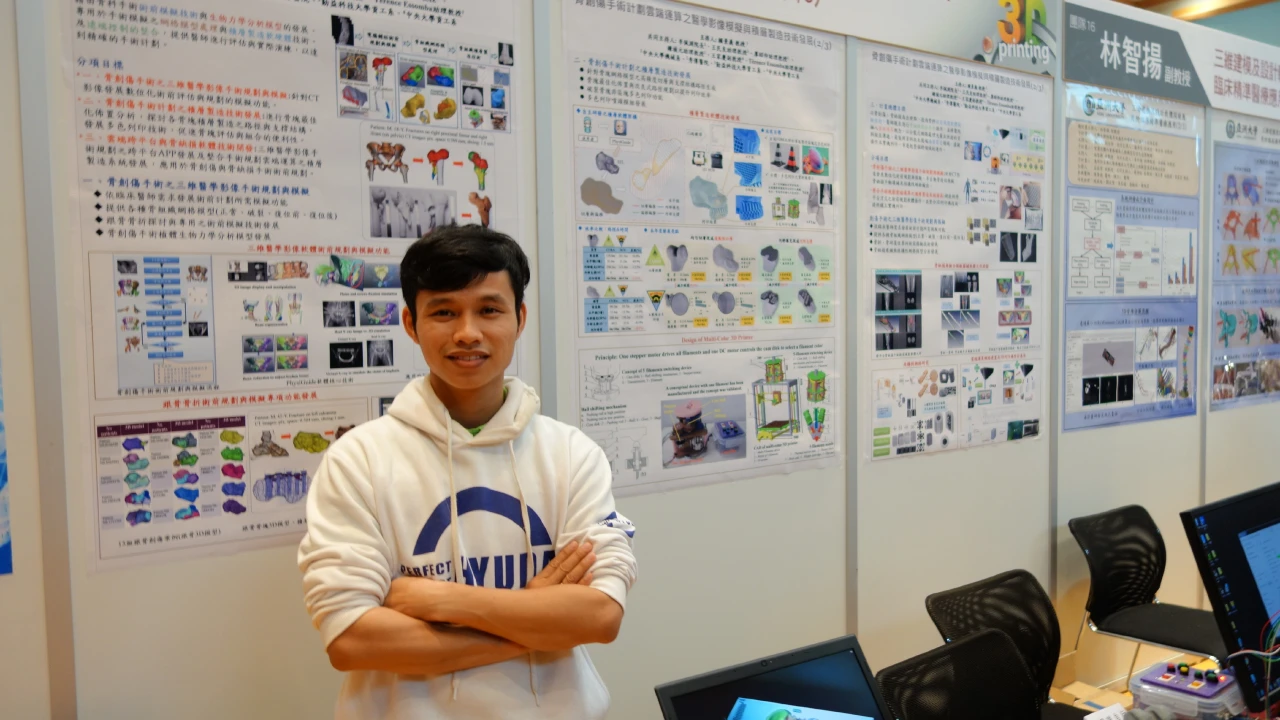
I am currently enrolled in a Ph.D. program in the Department of Mechanical Engineering at National Central University, specializing in design and manufacture. I am delighted with my decision to study for both my master’s and Ph.D. in Taiwan. My master’s thesis focused on 3D printing, but I shifted my research to medical robots for my Ph.D. thesis, a relatively new field in my country. In Vietnam, the focus is mostly on industrial manipulators and mobile robots. I aspire to be one of the young researchers in my country who specializes in mechanical design for medical applications.
I didn’t encounter significant difficulties when planning to study in Taiwan. However, a common challenge for those applying for the Ministry of Education (MOE) Taiwan Scholarship is obtaining a certificate or letter from the chosen university confirming enrollment in an English program. Many applicants struggle to receive this letter from Taiwanese universities. Unfortunately, I had to withdraw my scholarship application due to this issue.
Comparing Study Experiences: Taiwan vs. Home Country
Firstly, the coursework in Taiwan is more challenging than in my home country. In Vietnam, completing two or three chapters of a book is often enough to pass a course. In contrast, Taiwanese courses require understanding at least 80% of the book’s content, along with numerous exams and assignments. It’s feasible to take ten courses per semester in my country, but that’s impossible in Taiwan due to the intensity of the studies.
Secondly, Taiwanese universities are well-equipped with laboratories for practical training and research. Each student project is complex and demands full-time dedication, presenting a significant challenge.
Lastly, the professors in Taiwan are highly knowledgeable and extremely supportive of international students, offering help with both academic and personal issues.
Career Impact & Post-Study Plans
The most significant achievement from my studies in Taiwan is gaining a clear vision of my future. While many from my country attain a Ph.D. through various means, not all continue their academic pursuits post-graduation due to stress, long durations of study, and inadequate salaries. However, I feel confident in my abilities and knowledge and am eager to contribute significantly after completing my Ph.D. program.
Despite my efforts, I have not mastered Mandarin, which may be due to my language memory. I devoted considerable time to studying in Taiwan, utilizing books from professors and the library, many of which are prohibitively expensive in Vietnam. I plan to write a similar book in Vietnamese using the knowledge I’ve gathered. I also collected second-hand books on mechanical, electrical, and electronic engineering to establish a mini-library for my future students.
Regarding research, I believe my experience in Taiwan will significantly benefit my career. I envision becoming a professor and contributing to university education in Vietnam. I learned valuable skills in research methodology, proposal writing, laboratory management, and student supervision. My advisor in Taiwan has been an exceptional mentor, and I consider myself fortunate to have worked with him.
Many have suggested I stay in Taiwan after graduation due to its favorable work environment, healthcare system, and proximity to Vietnam. However, I am inclined to return to Vietnam. I feel responsible for imparting the knowledge and experience I gained in Taiwan to future generations. I am currently drafting a proposal for international research collaboration involving National Central University in Taiwan, my former university in Vietnam, and an Indonesian university. This initiative aims to foster academic exchange between these countries.
Advice for Prospective Students in Taiwan
For those considering studying abroad, particularly in Taiwan, it’s crucial to be prepared. Good health is essential as you’ll be living without close relatives. Friends can offer support, but self-care, especially health maintenance, is vital. You also need robust knowledge and a positive mindset to overcome initial language and study challenges. Confidence is key; Taiwanese and foreign students are amiable and open to sharing experiences and knowledge. They are often willing to engage with your family, making the transition easier.